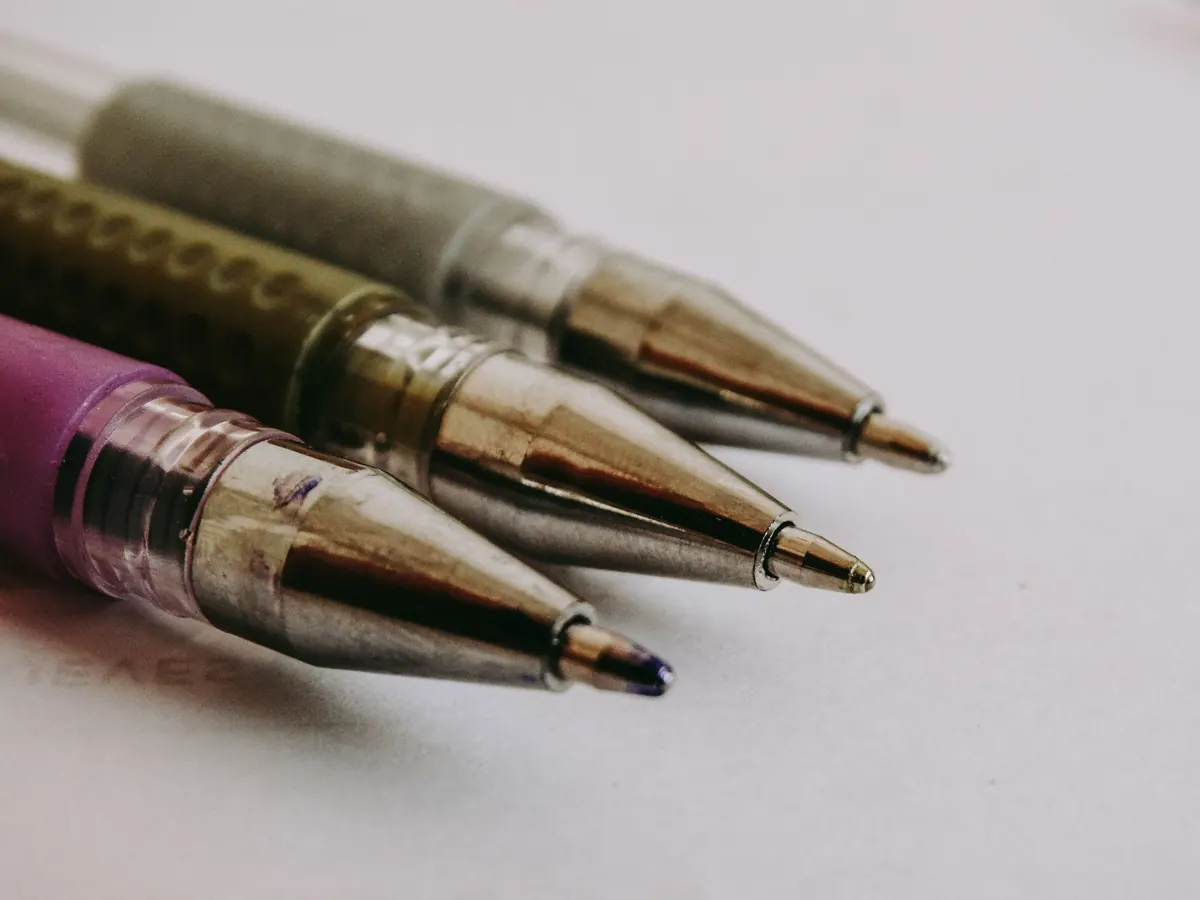
There is a particular kind of disappointment in picking up a favourite pen, finding the ink has run dry, and then discovering that the right refill is harder to buy than you expected. On a shelf, ballpoint refills look almost identical. A millimetre of difference in the wrong place, though, turns a two-minute purchase into a wasted trip. Matching a refill is a measuring job rather than a guessing job, and the steps below will take you from a dry pen to a correct order in a few minutes.
Start With the Pen, Not the Refill
Before you look at refills, identify what you are actually refilling. Check the barrel and the clip for a brand name and model number; most manufacturers print them, often in small type near the cap. A Pilot, a Lamy and a Cross pen of roughly the same age may all look similar in a drawer but take completely different refills.
Then note how the pen works. A click pen and a twist pen usually take a straightforward barrel-shaped refill, while a capped pen may take a slimmer cartridge with a longer exposed tip. Take the pen apart and remove the spent refill if there is one. If the pen is new to you and already empty, the inside of the barrel or the maker's website is the place to look.
Find the refill code
Most refills carry a small code stamped or printed on the tube, or on the plastic tail plug. Typing that string into a search engine is often the fastest route to an exact match. Photograph it before you throw the old refill away — you will want it as a reference.
Four Measurements That Decide Everything
Measuring takes two minutes and removes most of the risk. A steel ruler against a flat edge is enough. A cheap pair of digital calipers is better and costs very little if you plan to do this more than once. Work in millimetres.
Write down the following:
- Overall length — from the very tip of the writing end to the flat end of the tube, including any plastic tail.
- Body diameter — the widest part of the reservoir, usually the metal or plastic tube.
- Neck diameter — the narrower front section that sits inside the pen's cone.
- Tip profile — how far the narrow section extends, and where the step up to the wider body begins.
- The tail — flat, stepped, capped, or fitted with a small collar. This is the part the click mechanism pushes against.
Two refills can share a length and still not fit, because the neck is too fat for the cone or the shoulder sits in the wrong place. If the refill drops in but rattles, the problem is usually the tail. If it will not seat at all, the neck or the shoulder is wrong. Those two symptoms will save you a lot of squinting.
Tip Size: Fine, Medium and Broad
Refill tips are described by the diameter of the ball itself: 0.5 mm, 0.7 mm, 1.0 mm and so on. The line the pen draws is narrower than the ball, because ink is drawn out of the gap between ball and socket as you write.
Brands do not use the words consistently. One maker's "fine" is another's "medium", so compare the number in millimetres wherever you can. A finer tip suits small handwriting, forms and carbon copies, but it feels scratchier and can skip on rough paper. A broader tip lays down more ink and gives a bolder signature, at the cost of a longer drying time. Medium sits in the middle for good reason.
Ink Type Matters as Much as Fit
Oil-based ink
The classic ballpoint paste. It starts a little slowly, dries quickly on the page, and smudges less than the alternatives, which is why it remains the default for forms and cheques. It is also the kinder choice for left-handed writers.
Gel and hybrid ink
Gel ink is pigment suspended in a gel carrier. It flows more smoothly and looks darker, but it sits on the surface for longer and smudges more easily. Hybrid or low-viscosity inks aim for the middle ground: gel-like flow with faster drying.
Some refills are sold as document or archival refills, claimed to resist water and solvents. Check the specification printed on the packaging rather than assuming, and treat marketing language with polite scepticism. A gel refill of the right dimensions will generally work in a pen designed for oil-based ink, but expect a different feel and a longer dry time.
Standards, Families and Proprietary Fits
A handful of refill shapes are shared across many brands, which is why some are sold as fitting "most pens". The best known is the Parker-style refill, a standard length of roughly 98 mm with a stepped neck, often labelled "G2" or "Euro-style" by retailers. Do not confuse it with the Pilot G2 gel refill, which is a completely different shape. The tiny D1 refill, used in multi-pens and pocket pens, is another shared standard.
Beyond those, expect proprietary designs. Cross, Lamy and several Japanese makers use their own refills, and two pens from the same brand may take different ones. If you cannot work out a match, take the spent refill to a stationer who keeps loose stock and ask them to try it against what they have. Independent pen shops are usually glad to help, and it beats ordering blind.
A Short Checklist Before You Buy
- Brand and model of the pen.
- Length, body diameter, neck diameter and tail shape, in millimetres.
- Tip size in millimetres, not just "fine" or "medium". <
Photo: Romina BM / Pexels