Most fountain pen problems are not the pen's fault. A nib that scratches, a feed that clogs, a barrel that suddenly leaks — these usually trace back to a few small habits picked up in the first weeks of ownership, when the pen still feels like something precious and slightly mysterious. The good news is that every one of them is easy to unlearn, and doing so costs nothing but a little patience.
Over-tightening the cap and barrel
New owners treat a fountain pen like a jam jar. Tighten it until it squeaks, and you feel reassured that it is safely closed. In reality you are slowly wearing the threads, and on a plastic section you may eventually crack the collar where the barrel screws on.
The rule is simple: tighten until the pen stops, not until you feel resistance. A cap should seat with a light twist of the fingers. If the cap is a push-fit — common on vintage pens and on some modern pocket models — it clicks or settles with a gentle push, and forcing it further only wears the inner cap.
Converters and cartridges deserve the same restraint. Push a cartridge straight in until it seats, then stop. A converter pushed in at an angle, or twisted when it should be pushed, cracks at the neck. You will not notice immediately; you will notice three days later, when ink appears on your fingers halfway through a meeting.
Reaching for ink that isn't fountain pen ink
This is the mistake that ruins pens rather than merely annoying you. Drawing ink, India ink, calligraphy ink, acrylic, gouache and anything labelled "waterproof pigment ink" for dip pens contain shellac, binders or heavy pigment that sets solid inside the feed. Once that happens, no amount of flushing at home will shift it. The pen needs to be dismantled and cleaned properly, and sometimes the feed has to be replaced.
Within the world of proper fountain pen ink, there are still a few sensible cautions:
- Pigment inks are perfectly usable, but they need flushing more often. Monthly is a reasonable habit if the pen is in daily use.
- Shimmer and glitter inks settle in the feed. They behave best in medium and broad nibs; keep them away from extra-fine nibs and pens with narrow ink channels.
- Traditional iron gall inks are more acidic than most modern dye inks. Lovely for archival writing, but do not leave them drying in a pen for weeks.
- Highly saturated staining inks — the notorious bright blues and purples — can tint a clear demonstrator permanently. Give them a dedicated pen if the clarity of your barrel matters to you.
- Mixing brands in the same pen is a gamble. Two inks that are fine alone can react and drop sediment into the feed.
Cleaning too rarely, or far too aggressively
Ink is a suspension of dye and water. Leave it sitting in a feed for months and the water evaporates, leaving a crust that narrows the ink channel and causes hard starts. Flush a pen in regular use every four to six weeks, and always between colours unless you actively want a muddy blend.
- Expel the remaining ink onto a tissue or into a waste jar. Never return it to the bottle; that is how contamination and mould get into a whole supply.
- Draw and expel cool water repeatedly until it runs clear. Warm water is fine; hot water is not.
- For stubborn dried ink, add a single drop of washing-up liquid to a cup of water, flush it through, then rinse with clean water.
- Wrap the nib in a paper towel and stand the pen nib-down overnight so capillary action pulls the last of the water out.
What not to do matters just as much. Avoid alcohol, acetone, bleach and household ammonia unless you know exactly what your pen is made of and what dilution is safe. Do not soak vintage celluloid or casein pens, and do not pull the nib and feed out of the section simply because you want it shiny. Misaligned nibs and cracked collars are far more common than genuinely dirty feeds.
Storing a pen badly
Heat and light are the two enemies here. A pen left on a sunny windowsill or in a car can soften and distort the feed, and sunlight will gradually change the colour of ink in a clear barrel. Keep pens in a case, a sleeve or a drawer, out of direct sun.
For anything you will not touch for a month or more, empty and flush it first, then store it dry, either horizontally or nib-up. A capped pen that still holds ink should sit horizontally or nib-up too. Storing one nib-down in a mug lets gravity and capillary action push ink into the cap, where it pools, dries and eventually transfers itself to your fingers every time you open the pen.
Cartridges are more forgiving but not indestructible. Keep spares sealed and upright, and use them within a reasonable time rather than letting a bagful sit in a hot cupboard for years.
Pressing too hard and writing at the wrong angle
A fountain pen delivers ink by capillary action, not by force. If you are used to a ballpoint, your hand is almost certainly pressing far harder than it needs to. Ease off until the pen feels like it is gliding and the line is still steady. Your wrist will thank you, and the tines will keep their alignment.
Aim for a writing angle of roughly 40 to 60 degrees from the paper. Lying the pen almost flat can cause dry starts; holding it near-vertical makes even a smooth nib feel scratchy. Paper matters as well — coarse recycled stock and cheap copier paper wear a nib faster and encourage you to press harder.
One last courtesy to your pen: do not lend it. A colleague signing a delivery note with a ballpoint-trained hand can spring the tines in a single flourish. Keep a cheap rollerball in your drawer for exactly that purpose.
A routine that prevents almost every problem
Cap snug, not tight. Fountain pen ink only, with pigment and shimmer inks reserved for pens you are happy to flush often. A proper flush every month and every time you change colour. Store pens out of heat and sunlight, nib-up or flat.
Learn those four habits and the pen you bought will still write exactly as it did on the first day a year from now. Treat it roughly and you will spend more time troubleshooting than writing, which rather defeats the point of buying something this enjoyable in the first place.
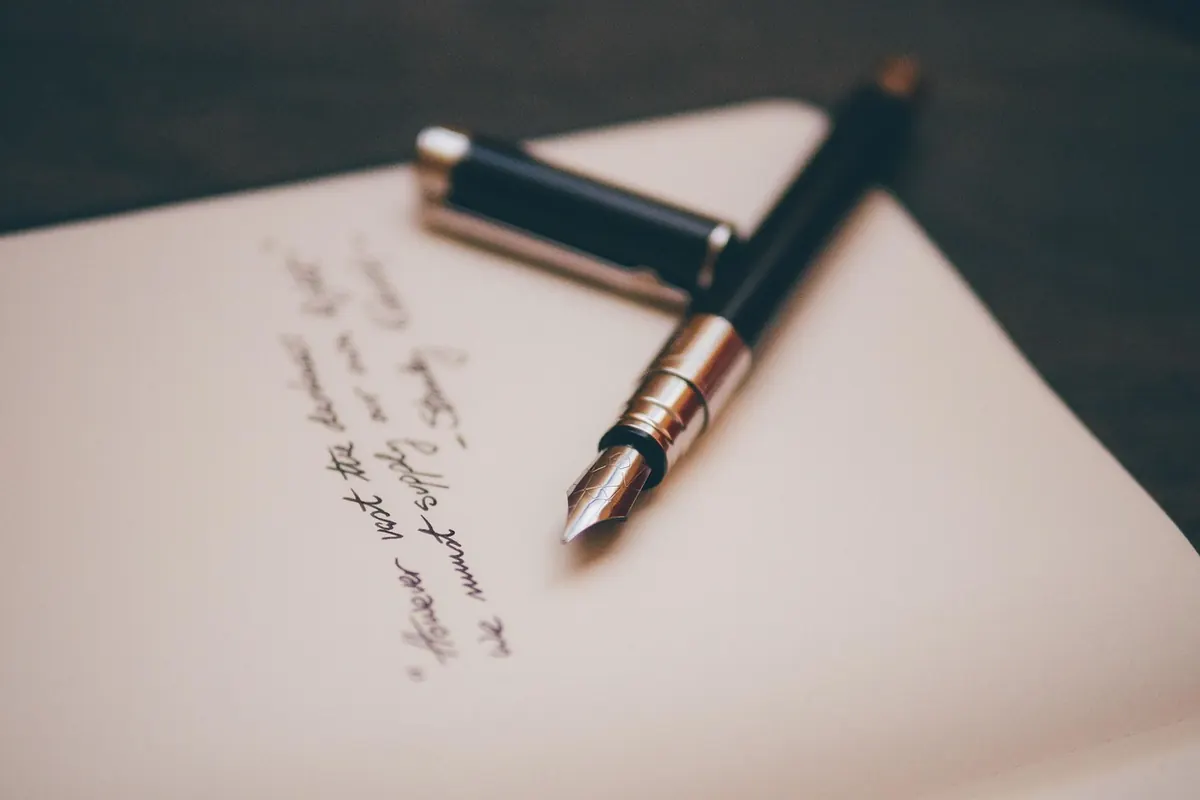
Photo: Pexels / Pixabay