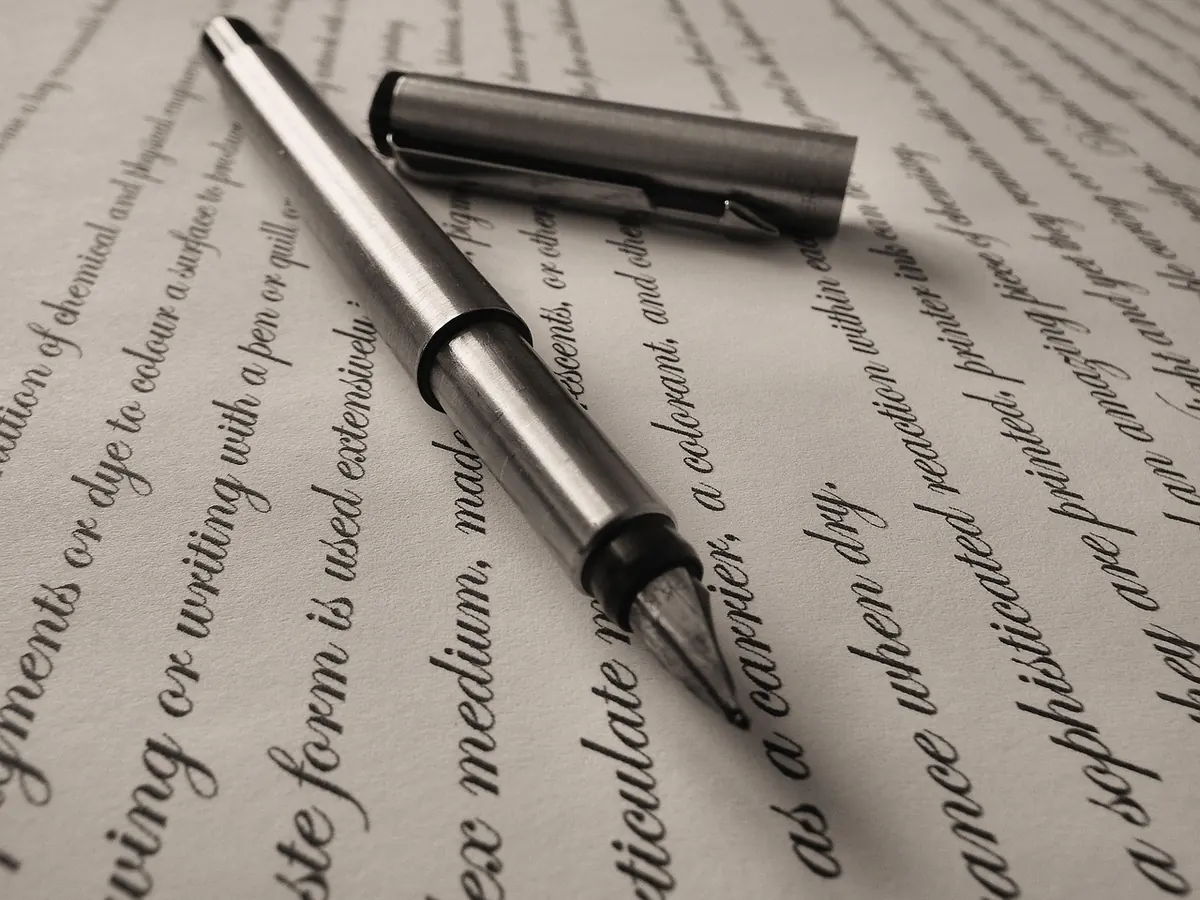
A fountain pen nib is the only part of the pen that touches the page, and its width decides a great deal about the experience: how large your letters appear, how much ink reaches the paper, and how forgiving the pen feels when you are writing quickly. The letters on the box — EF, F, M, B — look precise, but they are closer to a rough guide than a fixed standard. Two pens both labelled medium can write visibly different lines. Knowing what those labels mean, and what they do not, makes choosing your next pen much easier.
What the Letters Actually Mean
Extra-fine, fine, medium and broad describe the width of the tipping material — the hard pellet welded to the end of the nib — and therefore the width of the line it lays down. The order is fixed. EF sits at the narrow end, B at the wide end, and there is no universal standard in between.
The biggest single factor is where the nib was made. Japanese nibs from Pilot, Platinum and Sailor generally run finer than European ones, so a Japanese medium often writes close to a European fine. German and Italian mediums tend to be broader and wetter. Even within one brand, the same nominal size can shift slightly between models, and older pens sometimes differ from current production.
You will also meet sizes beyond the basic four: double broad (BB), triple broad, and Japanese extra-fines fine enough for dense annotation in a crowded notebook. Treat all of them as relative descriptions rather than measurements you can rely on across brands.
The Four Common Widths at a Glance
- Extra-fine (EF): A hairline line, useful for very small handwriting, narrow forms and cheap paper that would otherwise bleed. It can feel slightly toothy and demands a light hand, especially on textured paper.
- Fine (F): The everyday workhorse. Legible in margins, comfortable for long notes, economical with ink and well behaved on average paper. Good for people who write small or at speed.
- Medium (M): The middle of the road and the safest first choice for most writers. Smooth, forgiving, and broad enough to show off the colour of an ink without flooding the page.
- Broad (B): Big, wet and expressive. Ideal for signatures, loose large handwriting and showing off shading or sheen in an ink. It drinks ink, needs decent paper, and can smudge for left-handers.
If you only ever buy one pen, a medium is rarely a bad guess. If your handwriting is compact, a fine will probably serve you better.
Line Variation: Size Is Only Half the Story
A broad round nib does not give you thick-and-thin strokes. It gives you a wider line, consistently. Line variation comes from the shape of the tip, not its width, and that is where stub, italic and flex nibs come in.
Stub and italic nibs
These have a flat, chisel-like tip rather than a rounded ball. Write with one and the downstrokes come out broad while the cross strokes stay narrow, which is what gives italic handwriting its crisp look. A stub is a softened italic, easier to use day to day. A 1.1mm stub is a popular starting point for people who want visible variation without learning formal calligraphy.
Flex and soft nibs
A flex nib has thin tines that spread when you press, widening the line as you go. Vintage flex pens do this dramatically; many modern "soft" nibs offer a gentler version. Flex rewards a slow, deliberate hand and punishes heavy pressure. If you press hard when you write, a stiff round nib will be far more comfortable.
Matching Nib Size to Your Handwriting
The most reliable guide is the height of your lowercase letters. Measure a typical a or e from top to bottom. If your letters are around two to three millimetres tall, an extra-fine or fine will keep them open and readable. Around four millimetres and up, a medium or broad will suit your hand far better — a finer nib may make your writing look cramped and spidery.
Speed matters too. Very fine nibs can catch on paper fibres when you write quickly, whereas mediums and broads glide. Joined-up writers usually prefer a smoother, slightly wider line; those who print neatly in small blocks often do best with a fine.
Left-handers should think about drying time as much as width. A wet broad nib plus a slow-drying ink is a recipe for a smudged page. A fine nib and a quick-drying ink make the whole exercise far less frustrating.
And there is nothing stopping you from keeping two pens in rotation — a fine for forms and diary pages, a medium or broad for letters and journaling. Many writers settle exactly there.
Ink, Paper and Flow Change Everything
The same nib can write two different-looking lines on two different days. A wet ink on absorbent paper spreads, so your fine starts behaving like a medium. A drier ink on a smooth, coated paper such as Clairefontaine, Rhodia or Tomoe River stays tight, and the line looks noticeably finer and crisper.
If your new pen writes wider than expected, check the ink and the paper before blaming the nib. If it writes too dry or skips, the tines may be slightly misaligned or too tightly set. That kind of adjustment is best left to someone experienced — practise on an inexpensive pen before touching anything valuable, and send a good pen to a professional rather than bending tines yourself.
How to Test a Size Without Buying Blind
- Write a few lines with your current pen on the paper you actually use, then measure the height of your lowercase letters.
- Try tester pens in a stationery shop, or visit a pen club or pen show where you can compare several widths in one sitting.
- Choose a model with easily swapped nib units. The Lamy Safari, Kaweco Sport and many TWSBI models let you change width cheaply.
- If you write small, go one step finer than you were planning. If you write large, go one step broader.
- Keep a simple note of pen, nib, ink and paper for each combination you try. Patterns appear within a few weeks.
- If a nib feels scratchy, check alignment, paper and pressure before assuming the width is wrong.
Choosing Your First Size
If you are buying your first fountain pen and have no strong preference, a medium from a European brand or a medium-to-fine from a Japanese one is a sensible starting point. It will be smooth enough to enjoy immediately and broad enough to show you what ink can do. From there, move one step at a time rather than jumping from extra-fine to double broad.
Remember that a nib can be professionally reground — a broad narrowed to a stub, a medium sharpened to a fine — but this removes material permanently, so it is a decision for a pen you already love, not a way to experiment. Borrowing is cheaper. Write a full page with each size you can lay your hands on, and your handwriting will tell you the answer long before any specification sheet does.
Photo: 6277974 / Pixabay